
Engineering · barcode in, rules applied
Prober Barcode Entry and LOT Handling
When the LOT number is typed into a prober by hand, one wrong character files a whole batch under someone else's name, and the cost lands later - in retests and in tracing. This project sends the LOT straight into the prober's own barcode interface: a rule engine checks it against the machine's own field definition, sends only what passes, and stops the rest at the door with the reason recorded. Nothing on the machine side is reprogrammed or rewired; the operator's job changes from typing to scanning.
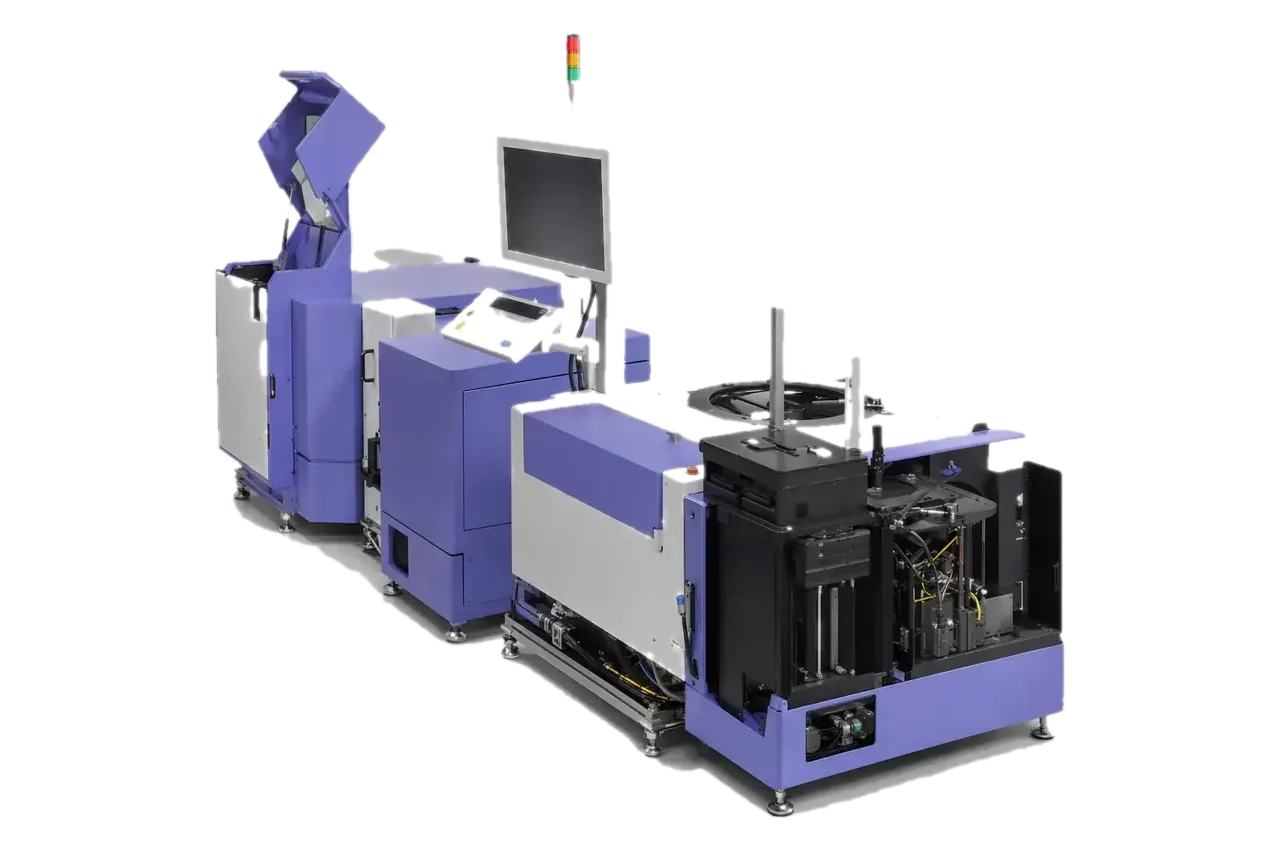
Prober category visual. The integration path follows the machine model and its interfaces.
The same points in words
- Stage
- Rules follow the machine's own field
- Path
- No keystroke emulation
- Rules
- First matching rule wins
- Validation
- Matches the machine's own field
Equipment and engineering solution
Applications
Designed for the following probe card manufacturing, test and maintenance tasks.
Replacing manual LOT entry
Extracting from mixed barcodes
Scan traceability
The same points in words
- Replacing manual LOT entry
- Scan instead of typing to cut batch-number mistakes.
- Extracting from mixed barcodes
- Take only the LOT out of a long code that also carries wafer and date fields.
- Scan traceability
- Every scan stays in the relay log, so the raw barcode behind each entry can be traced.
SPECIFICATIONS
Specifications
The final configuration follows the card, interfaces, site conditions and acceptance items.
See the full specification table
| Item | Specification / configuration | Notes |
|---|---|---|
| Failure policy | No rules means pass-through; a match that fails validation is not sent | Rejected scans are logged only |
| Rule deployment | Atomic snapshot replacement, hot-reloaded by the relay | No service restart to change rules |
| Traceability record | Barcode, LOT, wafer, device, operator, disposition | Records are written by the collector only |
WORKFLOW
Workflow
01 Interface check
02 Rule setup
03 Trial run
04 Delivery definition
The same points in words
- Interface check
- Confirm the barcode port, serial settings and the scanner on site.
- Rule setup
- Scan real barcodes, drag-select the LOT and preview the generated rule.
- Trial run
- Validate extraction and checking against real batches and watch the rejects.
- Delivery definition
- Set deployment scope and support model from the trial results.
FAT / SAT
Project delivery
Sample evaluation
Technical agreement
FAT
SAT
The same points in words
- Sample evaluation
- Confirm the object, interfaces, current state, failure modes and available validation samples.
- Technical agreement
- Define configuration, measurement method, limits, takt, data interfaces and responsibilities.
- FAT
- Verify functions, repeatability, reporting and exception handling with agreed samples.
- SAT
- Complete site integration, training, upstream/downstream interfaces and issue closure.
CONFIGURATION
Configuration and acceptance
System configuration, optional items and acceptance conditions are summarized below.
Stage and evidence
Rule engine, relay deployment and four-language operator screens are complete, with the check rules following each machine's own field definition. Scope is fixed per project.
Integration boundary
Only the machine's native barcode port is written to; the prober's own control software is untouched. Applicability depends on the model having that port.
Data boundary
Scan records are written by the collector and cannot be entered by hand; whether the machine accepted a LOT is decided by the machine's own record.
Share the card, interfaces and target
Send the sample, installed equipment, current issue and target takt. We will acknowledge receipt within one business day.